I love New York
The Design that Saved a City: The Story of the "I Love NY" Logo
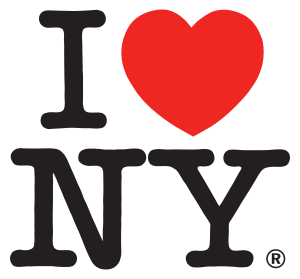
It is the most copied logo in human history, an omnipresent cultural icon printed on hundreds of millions of t-shirts, coffee mugs, and keychains worldwide. The "I Love NY" logo—with its bold, typewriter-style lettering and plump red heart—is so deeply embedded in global pop culture that it feels as though it has always existed. Yet, this graphic design masterpiece was born out of a specific moment of crisis, scrawled on a scrap of paper in the back of a yellow taxi.
Born from a City in Crisis
To understand the power of the logo, one must look at New York City in the mid-1970s. The city was on the brink of financial bankruptcy. Crime rates were at an all-time high, the streets were plagued by blackouts and transit strikes, and tourism had completely plummeted. The city had an image problem; it was seen as dangerous, dirty, and decaying.
In 1977, the New York State Department of Commerce decided to launch an advertising campaign to revitalize tourism. They hired the advertising agency Wells Rich Greene, who developed the slogan "I Love New York" and a catchy musical jingle. To bring the visual element to life, they turned to a legendary graphic designer: Milton Glaser.
The Scribble in the Taxi
Glaser expected the campaign to last only a few months, so he agreed to do the work entirely pro bono (for free), donating his rights to the state.
While riding in the back of a classic New York yellow cab, inspiration struck. Using a red crayon, Glaser sketched a rough concept on the back of a torn envelope: the letter "I", followed by a heart symbol, and the letters "NY" stacked below.
That crumpled envelope is now preserved in the permanent collection of the Museum of Modern Art (MoMA).
Deconstructing the Genius
The genius of Glaser’s final design lies in its deceptive simplicity. He utilized a typeface called American Typewriter, a choice that anchored the logo in a sense of grit, literary history, and unpretentious honesty.
By arranging the logo as a rebus—where a symbol replaces a word—he forced the human brain to actively participate in reading it. Your mind translates the visual heart into the verb "love" in a split second. The layout is perfectly balanced: a clean, geometric four-quadrant stack that fits flawlessly into a square, making it extraordinarily versatile for merchandise.
The Evolution: Post-9/11 ResilienceWhile the logo successfully boosted tourism in the late 1970s and 1980s, its emotional weight transformed dramatically following the terrorist attacks of September 11, 2001.
In the wake of the tragedy, the logo became a global symbol of solidarity, resilience, and collective grief. Glaser stepped up once again to modify his original creation. He created a special edition featuring a small black bruise on the lower left side of the red heart, accompanied by the text: "I Love NY More Than Ever." Posters of this version flooded the city, proving that the logo was no longer just a marketing tool—it was the emotional pulse of the people.
The Legacy of a MasterpieceMilton Glaser passed away in 2020, but his creation remains immortal. Today, the New York State Department of Economic Development owns the trademark, generating millions of dollars annually in licensing fees, which are funneled back into promoting state tourism.
The "I Love NY" logo proved that great design is not just about aesthetics; it can change the psychology of a population. It transformed New York from a city people feared into a city people wanted to belong to. It remains the ultimate love letter to Gotham—written in three letters, one symbol, and infinite passion.